
Tyche Softwares builds premium WooCommerce and WordPress plugins used by businesses around the world.
They approached us to develop a premium version of WP Content Copy Protection, but our initial technical review uncovered a more fundamental challenge: the existing Lite plugin needed a cleaner foundation before new functionality could be added reliably.
Rather than layering premium features onto the existing architecture, we first refactored the Lite plugin, established clearer extension points, and then developed WP Content Copy Protection Pro on top of it.
The engagement also introduced a more consistent development workflow and technical documentation, giving Tyche’s team a cleaner foundation for maintaining and evolving both products.
Project Highlights
WP Content Copy Protection Lite refactor, Premium Pro add-on development; clear separation of free and premium functionality; Composer-based dependency management and autoloading; Docker Compose development environment; improved JavaScript asset workflow; technical documentation and developer handover
Business Context
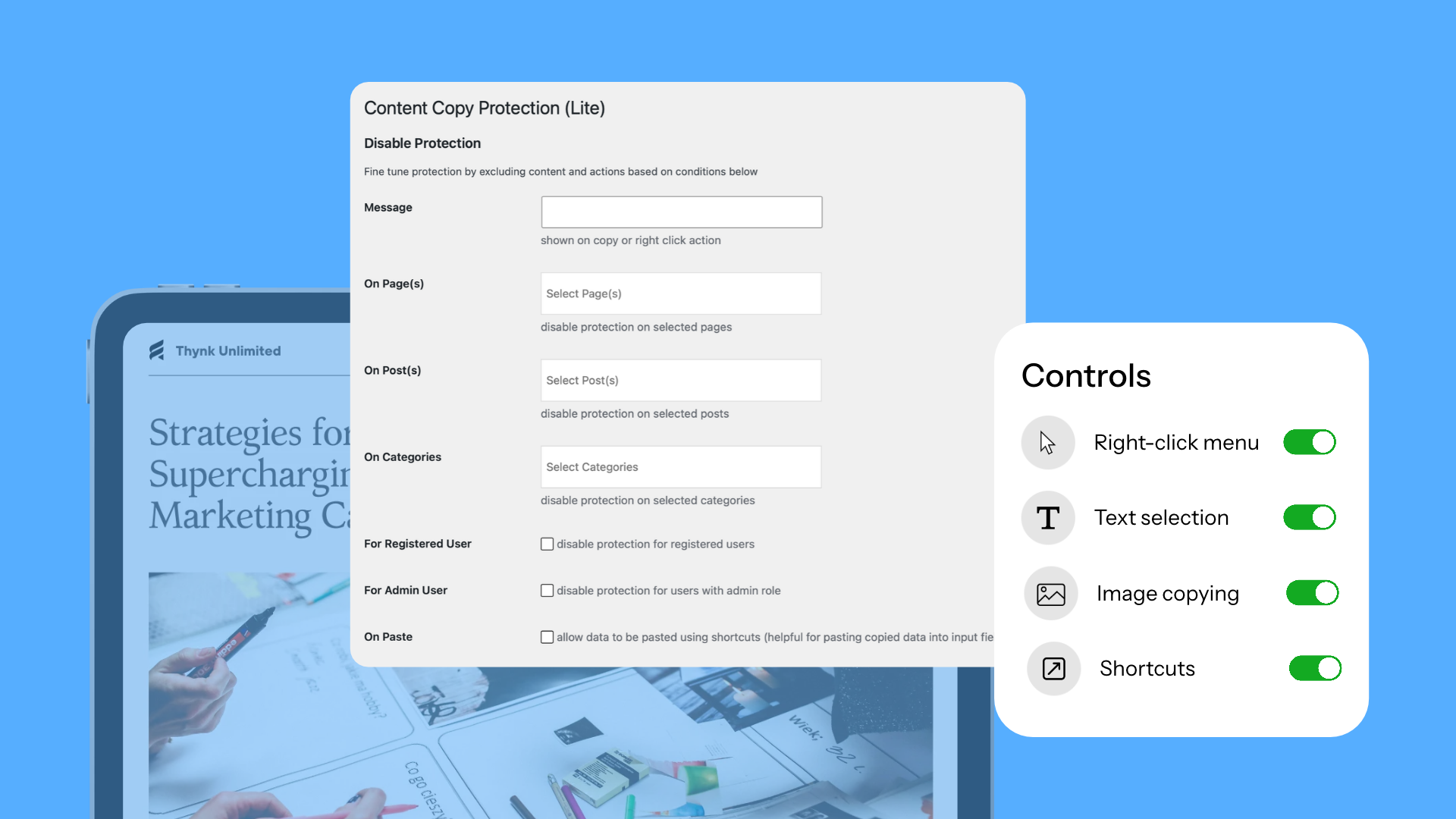
WP Content Copy Protection helps WordPress site owners discourage unauthorized copying and reuse of their content.
Tyche wanted to expand the product with a premium offering that introduced additional protection controls and functionality. But extending a mature plugin is rarely just a matter of adding features.
The free plugin already had an established codebase and existing users. Any architectural changes needed to preserve current behaviour while creating enough flexibility for the premium product to evolve independently.
The challenge was therefore not simply to build WP Content Copy Protection Pro. It was to create a technical foundation that could support both versions over the long term.
Building Pro Without Carrying Forward Technical Debt
The original scope focused on premium plugin development.
Before implementation, we reviewed the Lite plugin’s architecture, code flow, extension points, asset handling, and development setup. That review highlighted areas where the existing structure would make premium development unnecessarily difficult.
Building directly on top of it would have increased coupling between free and paid functionality, made the code harder to reason about, and carried those limitations into every future release.
Instead of working around the architecture, we addressed it first.
The project became a combination of targeted refactoring and product development: improve the existing Lite plugin without disrupting current behaviour, then create a clean architecture for extending it through Pro.
Refactor First, Extend Second
We started with a focused refactor of WP Content Copy Protection Lite.
This was not a ground-up rewrite. We concentrated on the parts of the plugin that affected maintainability and extensibility, reorganizing responsibilities and establishing clearer boundaries within the codebase.
With that foundation in place, we developed WP Content Copy Protection Pro as a separate premium layer.
Shared behaviour remained in Lite, while premium-specific functionality lived within Pro. This reduced duplication and created a clearer relationship between the two products, allowing new premium capabilities to build on the free plugin without mixing both codebases together.
We also improved the development environment around the plugins. Composer provided dependency management and autoloading, Docker Compose made local environments more reproducible, and the JavaScript build workflow created a cleaner way to manage frontend and administrative assets.
The result was not only a new premium product, but a more maintainable development system around it.
Key Work Delivered
01.
WP Content Copy Protection Lite Refactor
We reorganized key parts of the existing Lite plugin to reduce complexity and establish clearer responsibilities within the codebase.
The refactor preserved existing functionality while making the plugin easier to understand, maintain, and extend.
02.
WP Content Copy Protection Pro
With the Lite foundation improved, we developed the premium plugin as a distinct extension of the core product.
Premium functionality remained separate from shared behaviour, giving Tyche a cleaner free-to-Pro architecture without unnecessary duplication or tight coupling.
03.
Development Tooling
We introduced a more consistent development workflow using Composer, Docker Compose, and JavaScript tooling.
This improved dependency management, autoloading, local setup, asset handling, and the overall developer experience when working across both plugins.
04.
Technical Documentation and Handover
We documented the development setup, code structure, implemented functionality, technical decisions, and important considerations for future development.
This gave Tyche’s internal team the context needed to maintain the plugins and continue development after handover.
Operational Impact
The biggest outcome was not a single feature. It was removing an architectural constraint before it became embedded in the premium product.
Tyche gained a cleaner separation between Lite and Pro, making it easier to understand where shared functionality belongs and where premium functionality should be extended.
The refactored foundation also reduced the risk of future features adding unnecessary complexity to the codebase.
Alongside this, the improved development setup made environments more reproducible and established a clearer workflow for dependencies, assets, testing, and ongoing development.
Technical documentation completed the handover, giving Tyche’s team a practical reference for continuing the product internally.
“We worked with the Lubus team on one of our plugins. We approached them because we needed specific expertise in custom Gutenberg block development, among other things. We were very happy with the outcome they delivered – the code was clean, their processes were consistently followed, and they lived up to our expectations. We’re always looking for opportunities to work with them again in the future. I highly recommend the team at Lubus!”

Vishal Kothari
Founder
The Final Takeaway
Adding a premium tier to an established WordPress plugin can expose technical decisions that were perfectly reasonable when the original product was smaller.
Ignoring those constraints and simply adding more features usually compounds the problem.
For WP Content Copy Protection, we chose to strengthen the Lite plugin before building Pro. That decision created a cleaner relationship between the two products, reduced future maintenance overhead, and gave Tyche a foundation that could support continued development rather than becoming harder to change with every release.
Bring Us the Problem You’ve Been Working Around
Tell us what’s working, what’s become difficult, and where you want to go next – we’ll help you figure out the sensible next step.